The Japanese Heavy Metal Family Tree
A network map of bands, musicians, labels, festivals, venues and documented relationships across Japanese heavy music, 1967 to 2026, with the female led scene mapped member by member.
Work in progress. This map is not exhaustive. It presents the result of documented research at this release and changes as sources are added, corrected, or superseded. Every node is based on at least one public source and carries its sources and confidence class. If something is missing or wrong, submit it.
Public disclosure policy: This map uses public business records, public corporate filings, property records, public calendars, public civic documents, public press coverage and public listings. It maps commercial infrastructure and documented civic activity, not endorsements, partnerships or private cultural behavior. Inclusion does not require participation, consent or approval. The map corrects factual errors promptly and considers removal requests case by case where a listing is outdated, an entity has closed, publication presents a material safety concern, or the entity is not conducting public facing commercial activity. Public commercial infrastructure is mappable; private cultural behavior is protected.
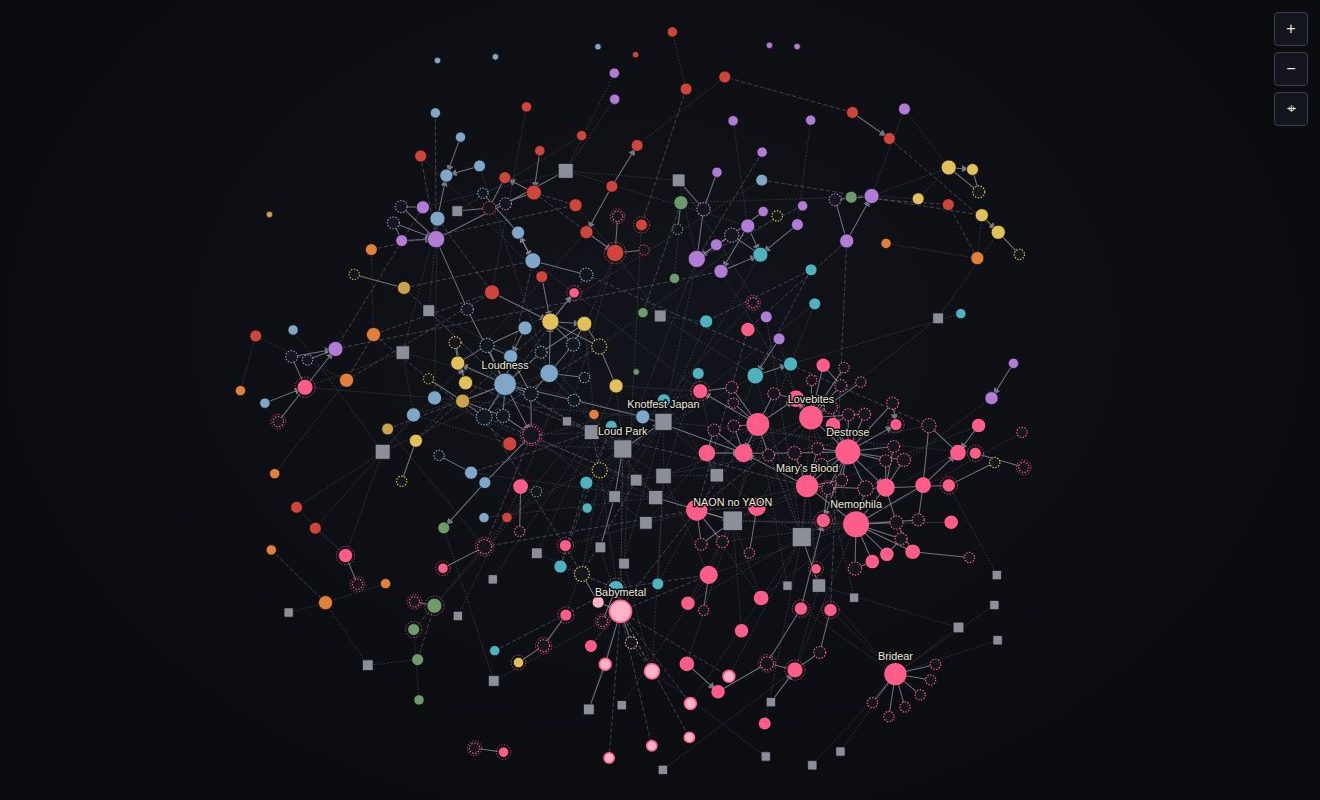 Network view. Three more: Lineage timeline, Cities and 3D, plus a Play animation from 1967 to 2026.
Read the reference
The same text as the PDF, generated from the same data file as the map, so the counts never disagree.
Current cases: how Japanese heavy music travels
Four bands singled out because each shows a different route from a scene network to international growth. Node size and centrality are computed, not adjusted.
Eleven lineages
Every band belongs to one lineage, the one that best describes the network it sits in. Open any lineage in the index of nodes.
Most connected in this dataset
Betweenness on the full graph: the nodes that bridge otherwise separate parts of the map. Full table and method.
- Lovebitesラヴバイツband · betweenness 0.170
- Loud Parkラウドパークfestival · betweenness 0.142
- JPU Recordslabel · betweenness 0.134
- Loudnessラウドネスband · betweenness 0.134
- Nemophilaネモフィラband · betweenness 0.117
- Anthemアンセムband · betweenness 0.091
- Crystal Lakeband · betweenness 0.086
- Babymetalベビーメタルband · betweenness 0.085
Data and downloads
The PDF reference, the Excel dataset and data.json, with the rules, the evidence standard and how to cite, on the data page.